Overview
Sheepshead is a trump-based, trick-taking card game. Each card has a point value, and the goal is to accumulate more points than your opponent(s) by winning tricks during play.
The Deck
Sheepshead uses standard playing cards but only the sevens through aces. The 4 suits are defined as clubs, spades, hearts, and trump. The trump suit consists of all queens, all jacks, and all diamonds. (So while all diamonds are trump, not all trump are diamonds!) The hierarchy of the trump suit is as follows with the Queen of Clubs Q♣ as the top trump and the 7 of diamonds 7♦ as the lowest:
The remaining Clubs, Spades, and Hearts are all called fail cards. The hierarchy of fail is A, 10, K, 9, 8, 7 in each suit.
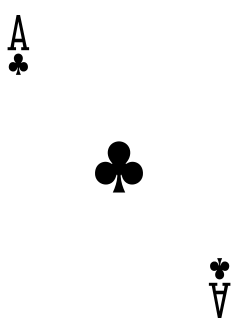
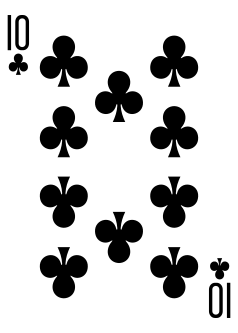
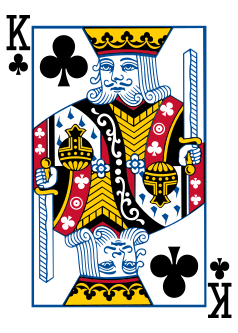
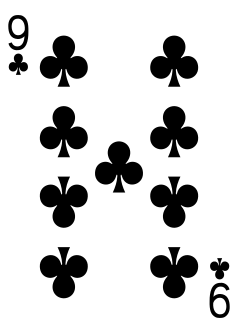
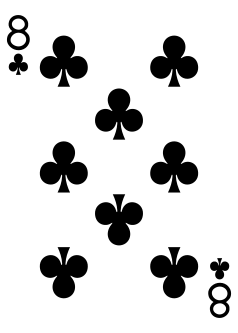
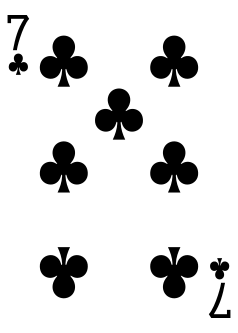
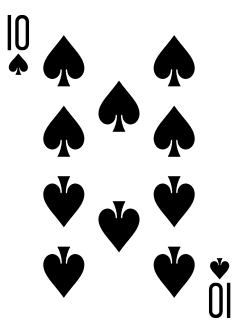
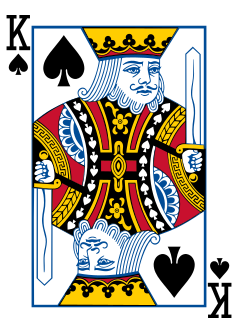
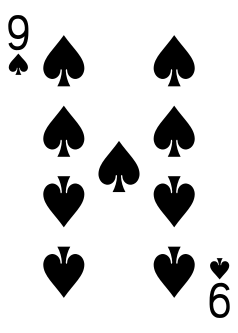
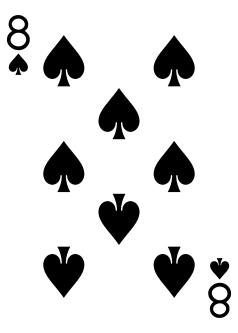
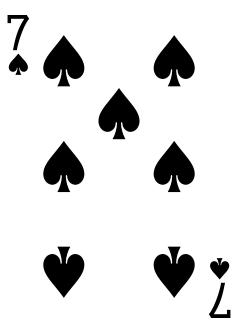
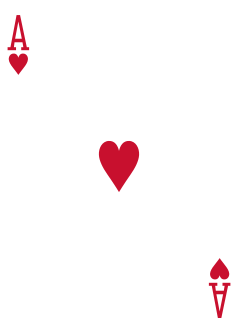
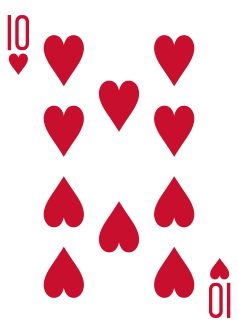
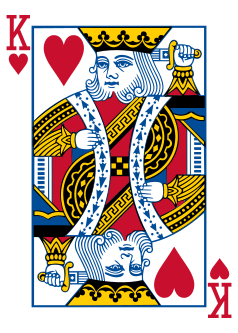
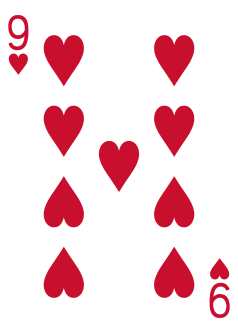
While trump cards are important in taking tricks, the criteria for winning a hand is how many points are taken. Points are the same in all suits (both trump and fail) and are as follows:
| Card |
Points |
| Ace |
11 |
| 10 |
10 |
| King |
4 |
| Queen |
3 |
| Jack |
2 |
| 9, 8, 7 |
0 |
The Deal
The deck is shuffled and dealt. Each player receives 6 cards and the dealer also deals 2 cards to the blind. The contents of the blind remains hidden until someone picks.
Picking
Starting with the player to the left of the dealer, each player has a chance to pick or pass. If a player picks, they add the blind cards to their hand and then replace them with any 2 cards of their choosing as their bury. The bury is out of play for the hand, but any points will still count towards the picker's total points. If a player passes, the choice to pick continues clockwise around to the dealer. If everyone passes including the dealer there are different scenarios which will be explained later under variations.
Partners
In normal play there are 2 teams, the picker and their partner as one team, and the remaining 3 players as the other team. The picker is known to all at the onset of the hand, while the partner is only revealed during play. The goal of each team is to take, through winning tricks, the most points they can.
Partners (Jack of Diamonds Rules)
When playing at a Jack of Diamonds rules table, when someone picks the player who has the Jack of Diamonds in their hand is automatically the partner. If the picker has the Jack of Diamonds (or if they pick it up in the blind) they may be able to call up to the next lowest Jack depending on the table rules (explained below).
Partners (Call an Ace Rules)
When playing at a Call an Ace rules table, the picker can call one of the fail Aces A♣A♥A♠ as their partner, or they may declare that they are going alone. In order to call an Ace as a partner the picker must have and keep a fail card of that suit in their hand (i.e., they cannot bury that card) and must only play that card when that suit is led (or on the last trick, if the suit is never led).
Going Alone
Under certain situations the picker may go alone and have no partner. They may either choose to go alone by announcing it to the table, or in the case of Jack of Diamonds rules, by having the Jack of Diamonds and not calling up to the next lowest Jack.
Play
Once the picker has buried and partner has been called (or not called), the play starts with the person to the left of the dealer. All players must follow suit if they can. If a player does not have the suit that is led they can play any card in their hand. They can play a fail card of a different suit (which cannot take the trick, but will contribute its points on the trick) or play a trump card (which will take the trick unless someone else is able to play a higher trump card).
When playing at a Call an Ace rules table, there are 2 additional restrictions on the picker and partner's plays:
- The only time the picker can play their called Ace fail card is to lead it, play it on a trick when that suit has been led, or play it on the last trick. In other words they cannot void themselves of that card prior to the suit being led.
- Similarly, the partner can only play their called Ace when that suit has been led, they can lead it, or play it on the last trick.
Awarding the Trick
To determine the winner of a trick, if there is any trump on the trick, the highest trump card takes it. If there is no trump card on the trick, the player with the highest card of the suit led wins the trick. These cards are set aside until the end of the hand when their points are tallied. Play then continues with the player who took the trick leading the next trick.
Determining the Winner of each Hand
When all tricks have been played and awarded, the picker and partner tally the points in the tricks either of them took, plus any points the picker buried to get their total. The opposing team does the same to determine their combined total. Whoever has the highest total wins the hand, with ties going to the non-picking team.
The total points of all the cards in the deck is 120. Therefore the picking team is looking to take 61 points to win (hence our name!), however the opposing team needs only to tie (60 points) to win.
Scoring
There is another breakpoint in scoring referred to as Schneider which is 31 points for the picking team, and 30 points for the opposing team.
Sheepshead is a zero sum game; any score that one person loses someone else gains and vice versa.
Scores are awarded as follows after each hand:
| Picking Team points taken | Opposing Team points taken | Picker Score Awarded | Partner Score Awarded | Opposing Team Score Awarded Each |
|---|
| All Tricks | No Tricks | 6 | 3 | -3 |
| 120-91 | 0-29 | 4 | 2 | -2 |
| 90-61 | 30-59 | 2 | 1 | -1 |
| 60-31 | 60-89 | -2 | -1 | 1 |
| 30-0 | 90-120 | -4 | -2 | 2 |
| No Tricks | All Tricks | -6 | -3 | 3 |
Note that while it is rare, it's possible to take 120 points without taking all tricks (or conversely to take a trick without taking any points). The "All Tricks/No Tricks" score brackets are specifically for when one team takes all tricks, not just all the points.
A very common scoring variation is Double on the Bump where if the picker and partner do not get 61 points they lose double the points listed in the table and the opposing team gains double the points.
Variations
When creating a new table you will choose which of the variations you want to enable or disabled.
Picking Options
Blitzers
Before picking, if a player has both Black or both Red Queens (Q♣Q♠ or Q♥Q♦) they have the option to blitz. Blitzing reveals to the other players that the picker has those two cards but doubles the stakes for the hand. If a player has all 4 Queens they can blitz either way but not both.
Call up to the next Jack after picking (Jack of Diamonds partner tables only)
When playing with the Jack of Diamonds partner rules, the picker normally has to call up to the next lowest Jack prior to picking up the blind. If they find the Jack of Diamonds in the blind, that means they cannot call up to the next Jack and they are effectively going alone. The variation to "call up after picking" allows the picker to call up to the next Jack after picking, or if they have the Jack of Diamonds they can choose not to call up and go alone without announcing it.
This option is often (but not always) paired with "Double On the Bump" with tables often having both or neither options in effect. So on tables where you may get the Jack of Diamonds in the blind and not be able to have a partner, the penalty for losing with picking is not also doubled.
When No One Picks...
Usually Sheepshead is played with one or more of these options available to the dealer if no one picks. Without these, the dealer (the last person with the option to pick) can only pick.
Leaster
The last player with the option to pick has the option to call a leaster instead. In a leaster there are no partners and each player tries to take the least amount of points but must take at least one trick to win. The player calling the leaster also chooses which trick (1-6) will take the blind. The player taking that trick adds the points in the blind to their total but does not reveal what the blind contained.
Doubler
The dealer has the option to Call a doubler. The dealer then redeals and the score value for the next hand is doubled. Depending on the table options, if all players pass on this second deal:
- The dealer must either pick or call a leaster.
- The dealer passes the deal and the doubler that was called transfers to the next player’s deal.
Schwanzer
The idea of the Schwanzer is to penalize a player who mauers (passes on a strong hand). When the dealer calls a Schwanzer, each player's hand is given a score with Queens being 3 points each, Jacks 2 points, and all other Diamonds as 1 point. Whoever has the highest score loses and pays each other player 1 point. If there is a tie for the highest score, the hand with the highest trump card loses.
Cracking/Recracking
If Cracking/Recracking is enabled, immediately after the picker has picked and buried but before the initial card is played, a person who is behind the picker in the picking order and who is not the partner has a brief window to "Crack". This is saying they believe they have a very strong hand and can beat the picking team. This doubles the stakes for the hand, and effectively announces to the table that they aren't on the picking team.
Either the picker or the (as of yet unknown) partner can "Recrack" if they believe they will indeed win. This doubles the stakes yet again. If it was the partner that Recracked on behalf of the picking team, then the partner is known to the entire table. Cracking/Recracking is the only way in Sheepshead that players can be excluded or confirmed to be the partner before play begins.